
Shop the collection
Reptile Lighting, Heating & Equipment
- 30-day easy returns
- Fast US delivery from multiple warehouses
- Secure checkout: Shop Pay, PayPal, Amazon Pay, Google Pay
343 products · Page 15 of 15


Reptile Lighting and Heating - UVB, Basking Lamps & Habitat Equipment
Reptiles are ectothermic animals that depend entirely on their environment to regulate body temperature, absorb UV radiation, and maintain essential biological functions. Without accurate reptile lighting and heating, even a well-designed habitat can fail to support proper digestion, immune function, bone development, and natural behavior. This collection covers the core equipment needed to build and maintain a stable, species-appropriate thermal and lighting environment - from UVB and full-spectrum lighting to heat lamps, ceramic heaters, heat mats, and precision thermostats.
Why Reptile Lighting and Heating Matter
In the wild, reptiles move between sun-exposed basking zones and cooler shaded areas throughout the day. Replicating this thermal gradient in captivity is not optional - it is a fundamental requirement for long-term health. UVB exposure drives vitamin D3 synthesis, which directly controls calcium metabolism and prevents metabolic bone disease. Basking temperatures trigger digestion and immune response. Nighttime temperature drops support natural rest cycles. Every element of a reptile's lighting and heating setup contributes to physiological stability that cannot be compensated for by diet or supplements alone.
Benefits of Proper Reptile Habitat Lighting and Heating
- Supports calcium absorption and bone health through consistent UVB exposure calibrated to species requirements
- Enables natural thermoregulation by providing a defined thermal gradient from basking zone to cool side
- Promotes healthy digestion by maintaining basking temperatures that activate metabolic processes
- Regulates circadian rhythms through consistent photoperiods that align with natural day-night cycles
- Reduces stress and behavioral issues caused by inadequate temperature or lighting conditions
- Improves immune function by keeping core body temperature within the species-appropriate range
- Provides reliable, consistent output through equipment designed for continuous operation in enclosed habitats
How to Choose Reptile Lighting and Heating Equipment
Selecting the right equipment starts with understanding the specific requirements of your reptile species. Desert species such as bearded dragons and uromastyx require high-output UVB and intense basking temperatures. Tropical species such as chameleons and crested geckos need moderate UVB and more controlled ambient heat. Nocturnal species such as leopard geckos require minimal UVB but consistent belly heat from mats or low-output ceramic emitters. Key factors to evaluate include:
- Species UVB index requirement - match the Ferguson Zone rating of the bulb to your reptile's natural UV exposure level
- Enclosure size and mounting distance - UVB output drops significantly with distance; select bulb strength accordingly
- Basking temperature target - confirm the wattage needed to reach the correct surface temperature at the correct distance
- Thermostat compatibility - not all heating equipment is compatible with all thermostat types; verify before purchasing
- Photoperiod control - use timers or programmable controllers to maintain consistent on/off cycles
- Nighttime heating needs - ceramic heat emitters and heat mats provide heat without disrupting darkness requirements
Types of Reptile Lighting and Heating Equipment
UVB Lighting
UVB bulbs are the most critical component of any diurnal reptile setup. They emit ultraviolet B radiation in the 290-315 nm range, which reptiles use to synthesize vitamin D3 through skin exposure. Linear T5 HO fluorescent tubes provide the widest and most consistent UVB coverage across large enclosures. Compact coil bulbs suit smaller setups or species with lower UVB requirements. Mercury vapor bulbs combine UVB output with significant heat output, making them suitable for large open-top enclosures. Replace UVB bulbs on the manufacturer's recommended schedule - output degrades before the bulb visibly dims.
Basking Lamps
Basking lamps provide the focused, intense heat that reptiles require to reach their preferred body temperature during active hours. Incandescent and halogen flood bulbs are the most common format, producing a concentrated beam of visible light and infrared heat. Halogen options run hotter and more efficiently than standard incandescent bulbs at equivalent wattages. Spot bulbs create a tight basking zone; flood bulbs spread heat across a wider surface area. Wattage selection depends on enclosure size, ambient room temperature, and the distance between the bulb and the basking surface. Always use a thermostat or dimmer to prevent overheating.
Ceramic Heat Emitters
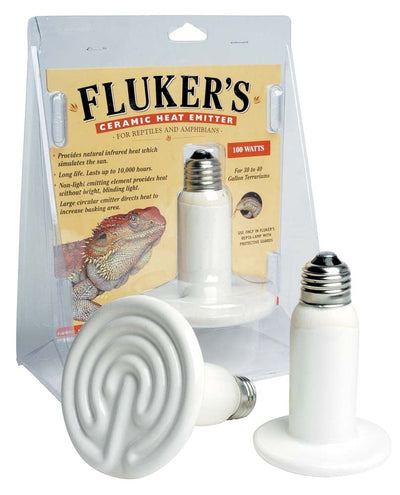
Ceramic heat emitters (CHEs) produce infrared heat without emitting any visible light, making them the preferred solution for nighttime heating or for species that require heat without light disruption. They screw into standard ceramic lamp sockets and operate continuously without affecting photoperiod. CHEs are available in a range of wattages and are compatible with pulse-proportional and on/off thermostats. They are durable, long-lasting, and suitable for both tropical and arid species that require stable overnight temperatures. Always use a ceramic or porcelain socket rated for the wattage being used.
Heat Mats and Pads
Heat mats and under-tank heaters provide belly heat by warming the substrate or enclosure floor from below. This is particularly important for species that rely on conductive heat transfer for digestion, including many snake and gecko species. Heat mats should always be used with a thermostat to prevent substrate overheating, which can cause burns or fire risk. They are not a substitute for ambient air heating in most setups but serve as an effective supplemental heat source or primary heat source for species with low ambient temperature requirements. Ensure the mat is sized appropriately - it should cover no more than one-third to one-half of the enclosure floor to preserve a thermal gradient.
Thermostats and Controllers
Thermostats are essential safety and precision tools for any reptile heating setup. They regulate the output of heating equipment to maintain a set temperature, preventing dangerous overheating and reducing bulb burnout from constant full-power operation. On/off thermostats are suitable for heat mats and ceramic emitters. Dimming thermostats are required for incandescent and halogen basking bulbs. Pulse-proportional thermostats are the most precise option for ceramic emitters and are preferred for sensitive species. Programmable controllers allow day and night temperature differentials to be set automatically, supporting natural thermal cycling without manual adjustment. Never operate heat lamps or ceramic emitters without thermostat control.
Frequently Asked Questions
What is the difference between UVA and UVB lighting for reptiles?
UVB (290-315 nm) enables vitamin D3 synthesis and is essential for calcium metabolism in diurnal reptiles. UVA (315-400 nm) influences behavior, appetite, and activity levels. Most reptile-specific bulbs emit both, but UVB output is the primary specification to evaluate when selecting a bulb for health support.
How often should UVB bulbs be replaced?
UVB output degrades over time even when the bulb still produces visible light. Most manufacturers recommend replacing linear T5 HO bulbs every 12 months and compact coil bulbs every 6 months. Use a UV meter to verify output if precise measurement is needed.
Can I use a heat mat as the only heat source?
Heat mats provide belly heat but do not raise ambient air temperature effectively. For most species, a heat mat alone is insufficient. It works as a primary heat source only for species with very low ambient temperature requirements, such as some gecko species in warm rooms. Always pair with ambient heating if needed.
Do nocturnal reptiles need UVB lighting?
Most nocturnal species have lower UVB requirements than diurnal species, but current research suggests that low-level UVB exposure is still beneficial for many nocturnal reptiles, including leopard geckos. A low-output UVB bulb on a natural photoperiod is generally recommended unless species-specific guidance indicates otherwise.
What type of thermostat do I need for a basking lamp?
Basking lamps require a dimming thermostat, not an on/off thermostat. On/off thermostats cycle power completely, which causes rapid bulb burnout in incandescent and halogen bulbs. A dimming thermostat reduces voltage to maintain temperature, extending bulb life and providing more stable heat output.
How do I create a proper thermal gradient?
Position your basking lamp or heat source at one end of the enclosure to create a warm basking zone. The opposite end should remain unheated to provide a cool retreat. Measure temperatures at both ends and at mid-enclosure using a digital thermometer or temperature gun. Adjust wattage and lamp position until the gradient falls within the species-appropriate range.
Build a Stable Environment with the Right Reptile Heat Lamp and UVB Lighting
Reptile lighting and heating equipment is the foundation of a functional habitat. Every product in this collection is selected to support accurate temperature control, reliable UV delivery, and safe continuous operation. Whether you are setting up a new enclosure or upgrading an existing system, use the guidance above to match equipment to your species' specific requirements. Browse the full range of reptile heat lamps, UVB lighting, ceramic heaters, heat mats, and thermostats to build a setup that supports long-term health and natural behavior.